What’s happening?
The game gathers hunger, energy, stress, boredom, curiosity and trust. Personality, age, day or night and nearby room destinations join the snapshot.
 POCKET
AI-POWERED CREATURES. VERY SMALL WORLD.
Not quite a pet. Not quite a monster.
A tiny, opinionated, what-on-earth-is-that
that fits right in your pocket.
Real AI chooses their next move. These little thinkers notice their needs, make choices and build familiar habits—all on your ESP32.

FIELD NOTES / 001 · RESIDENT IDENTIFICATION
Pick a weirdo to inspect.
Every creature below is drawn by the game itself.
YOU ARE OBSERVING
A purple rounded core, glossy orbiting lobes and a trailing three-finger hand. Its eyes, brows and little mouth have plenty to say.
VERY BOLD · BALANCEDFamily tendencies are a starting point. Every roommate is unique.
Real game reaction frames, replayed here so you can inspect every funny face.
FIELD NOTES / 002 · FINGERS REQUIRED
Tap, hold, sweep, squish, hatch.
Get to know every way to care.

TAP EMPTY HABITAT SPACE
A tap drops three meat morsels when there is room. Your gremlin decides when to approach. Watch for an actual bite: a food drop by itself doesn’t fill its tummy.
Extra bites still feed a friend. Discovery meals count at least 30 care minutes apart.
TRY A LITTLE PATIENCE
Keep your finger still. Keyboard: hold Space or Enter.
An interactive guide using real game images. Your ESP32 device is where your living colony plays.
THE LITTLE THINKING DEPARTMENT / AI INSIDE
A snack? A nap? A suspicious object?
Their next move is a little decision of their own.
Pocket Gremlins is powered by on-device neural AI. Each gremlin gets decisions based on its own needs, personality and surroundings. The brain evaluates possible activities and chooses what to do next, plus how urgent that activity is. You care for the world; your little weirdos respond.
The game gathers hunger, energy, stress, boredom, curiosity and trust. Personality, age, day or night and nearby room destinations join the snapshot.
The neural model evaluates available activities and picks an activity and urgency. Food, friends and room pieces need a real or remembered destination.
The game turns the chosen goal into movement and interaction: seeking food, visiting a toy, inspecting a curio, exploring, socializing or resting.
Real bites, rest and visits change needs. Experiences shape memories. A later decision uses the updated snapshot, so their next move can change.
↳ CHANGED NEEDS + MEMORIES FEED THE NEXT DECISION
Pick a situation. Follow the clues through the brain to one possible next move. Needs and personality shape the choice, so it isn’t a command or a guaranteed outcome.
CLUES GO IN →
Evaluates activities.
Chooses a goal + urgency.
ONE POSSIBLE NEXT MOVE →
A snack sounds like a very good idea.
A real morsel in this room
Hunger and a nearby morsel give the brain something useful to consider. One possible choice is to go looking for that food.
An actual bite fills the tummy. Dropping food or walking toward it alone doesn’t count as eating.
An illustrated guide to possible AI decisions, using actual game animation frames. The creature AI runs on your ESP32 device.
A meal, a clean floor, cozy cover or a calm hold changes the world and the gremlin’s needs. The AI chooses how to respond. A toy poke is an invitation to investigate.
Favorite toys, curios and sleeping spots belong to each gremlin in each habitat. Regular feeding locations are remembered by the room. These destinations influence later choices. Meet their little habits →
The neural AI runs locally on the ESP32. Everyday creature decisions work offline. Each resident gets its own decisions; the game keeps movement and animation going between them.
It reads a compact state snapshot. Needs, personality, life stage, day or night and distances to available destinations become the input to a small neural network.
It evaluates possible activities. The network produces scores for actions. Choices requiring a destination use available targets, including remembered feeding spots. A missing roommate cannot become a social destination.
It chooses a goal and urgency. That result tells the game which activity to pursue and how urgent it is. Decisions happen at intervals and when fresh information calls for another choice; the neural network does not run for every animation frame.
The game makes the action happen. Movement, bites, rest, care, growth and genetics follow the game’s rules. Actual interactions update needs and memory, which influence later AI decisions. A remembered snack spot can guide a search; only eating real food fills a tummy.
Every resident brings its own needs and personality to the next choice. Your device is where the living colony plays.
FIELD NOTES / 003 · HABITAT HOPPING
Three rooms. A change of scenery.
The same delightfully peculiar friends.
SOFT THINGS. STRANGE ROOMMATES.
Stitched curtains. Scalloped canopy. Hanging nests. A woven rug and gently moving fabric. A snug little first home.
Open the Spooky Annex with its room control. Move every resident out before closing it. Changing the room view does not move your friends.
THE DEPARTMENT OF VERY PERSONAL LITTLE HABITS
One likes a toy. One claims a nest.
Every weirdo has its own little ways.
A LITTLE EXPERIENCE. A LITTLE PREFERENCE.
Real playtime helps a gremlin find a favorite. A familiar toy can draw another visit, even when a different piece is active. A happy visit helps ease boredom.
Give them time to explore. A tap is an invitation; their little brain chooses what to do.
Favorite pieces and cozy sleeping spots stay remembered when you restart. Each gremlin keeps its own favorites for each habitat.
Cozy napper? Curious collector? Little explorer? Their routine describes what they actually do. It grows from experience, with no fixed timetable.
Some friends keep exploring before choosing a favorite. Let their needs and personality lead. A new experience might become a new favorite.
Their local little brain chooses activities; real visits shape memories, curiosity and boredom, which influence later decisions. Read more in the care manual →
FIELD NOTES / 004 · HEREDITARY WEIRDNESS
Shapes, colors, eyes, appendages.
Little bits of both parents. A lot of surprise.
 CERTIFIED
The first discovery egg comes from two counted meals, calm holding, cleaning and good health. It brings a different founder family. You decide when to hatch it.
Healthy, fed adults need the same room, nursery cover, clean walls and a low-mess floor. Real nearby social behavior builds their bond; sitting on screen together doesn’t do it.
Body shapes, appendages, colors and natural variations can come from different family branches. Grown hybrids can have offspring too. Lineage shows ancestry and parents.
The website shows captured possibilities from the real genetics renderer. On your device, an egg’s identity is fixed when it forms.
FIELD NOTES / 005 · LITTLE GROWING PAINS
New proportions. Developing appendages. Little creases and different wiggles. Each life stage has a look and movement of its own.
Baby proportions, short appendages and a small starting set of little limbs. Watch the tiny bob and stretch! Choose your first family and offer a real meal to begin healthy growth.
These are accumulated healthy care times, not promises of a stage change after exactly that much wall-clock time. See every family at every age →
 SAME FRIEND. A NEW LITTLE CHAPTER.
THE TINY CALM-DOWN CLINIC / ALL WEIRDOS WELCOME
Even a little monster needs a cozy day.
Pick a worry. Find a friendly fix.
WHAT’S BUGGING YOUR LITTLE BUDDY?
Crumbs and floor litter keep a gremlin feeling frazzled. The messier the floor, the harder it is to settle down.
Give the room a gentle sweep. Use Sponge to tidy up while keeping the leaves safe.
Clean floors help stress fall. Wall fuzz needs its own wipe, too.
Rest and leafy shelter help stress fall.
These are the game’s real rest frames.
THE LITTLE GET-WELL GUIDE
Big care needs can become a little illness when they stay unmet for too long. Watch the warnings: they tell you what your buddy needs.
Food is almost gone. Offer morsels and watch your gremlin actually take a bite.
Rest is almost gone. Let your buddy recharge at the cushion and keep its night rest routine.
The floor is extremely dirty. Sweep away litter and keep the room comfortable.
Serious unmet needs add up. After six accumulated care hours, a gremlin can become ill. Meeting its needs makes that buildup shrink. Vacation pauses the care clock.
YOUR GET-WELL RECIPE
A real meal + a cozy rest + a clean floor. If your gremlin is ill, tap it → MORE → TREAT for medicine. Recovery takes good care over time; medicine gives it a head start.
A still four-second hold builds trust, too. Practice a little patience ♡ →
The illness check watches three urgent needs: Food at 20% or less, Rest below 15%, or floor mess above 85%. Unmet needs accumulate toward six care hours. When all three are out of those critical ranges, the buildup decreases twice as fast as it increased.
Illness adds stress. Stress by itself does not trigger illness, and illness does not spread between roommates. Bare rooms and crowded greenery affect comfort separately.
A sick gremlin recovers after two accumulated care hours with those urgent needs met. TREAT gives a one-care-hour head start and a small energy boost. If an urgent need returns, recovery progress resets. Keep feeding, resting and cleaning after medication.
Night rest slows needs; Vacation pauses care. The last remaining friend can still get sick and needs your care, even though it cannot leave.
FIELD NOTES / 006 · THE NO-OBVIOUS-QUESTIONS MANUAL
The full care manual.
Open a note. Learn a monster thing.
Tap an empty patch of habitat to offer three meat morsels if food slots are free. Your gremlin chooses when to approach and eat. Consumed food restores hunger and energy; a tap alone does not. Chewing and gulping start after an actual bite.
A counted player meal starts a 30-care-minute discovery interval. Other bites still feed the gremlin without counting as another discovery meal. Egg Care shows the wait. Ordinary daytime care is roughly a meal every four hours; watch each friend’s needs.
Put tools away and close menus. Hold your finger calmly near a resident for four real seconds, without dragging. Successful holds build trust, meet the holding care requirement and prompt a lean, wink or affection puff. A six-second repeat cooldown gives each moment space.
Trusting, nonhungry gremlins can approach a settled finger. Knot contracts its loop, Maw works its lips, Cap folds its sails, Orb waves and Twig bows. A quick tap opens a card; a moving finger performs room care.
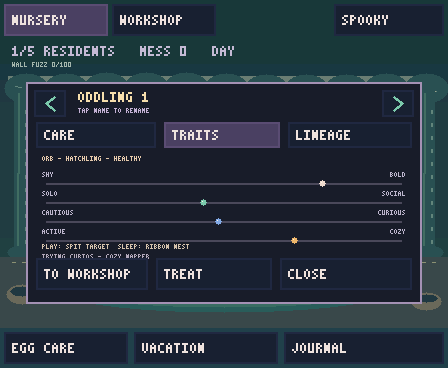
Food is fullness; Rest is energy; Stress is unease; Trust is connection with you. Low stress is good. The compact card shows shy–bold, solo–social and cautious–curious tracks.
MORE → CARE adds boredom, healthy growth time and roommate bond progress. MORE → TRAITS adds family, stage, health, active–cozy, favorites and the observed routine. These are living readings, not editable sliders. Care and their own behavior change them.
Each gremlin remembers its own favorite play toy, curiosity piece and bed or nest in each habitat. Actual visits shape preferences; some friends explore for longer before choosing. Successful play and investigation ease boredom and curiosity, helping shape later decisions.
MORE → TRAITS shows favorites and the observed routine. Memories and exact sleep destinations survive restarts. Moving rooms keeps the memories for the old room; changing roommates does not hand those memories to someone else.
Moving a piece moves the remembered destination. Removing it lets the gremlin use an available alternative; reintroducing that kind restores its remembered preference. Repeated new experiences can change a favorite. Routines describe real behavior rather than a fixed schedule, and favorite visits do not count as meals or growth care.
Explore the Department of Personal Little Habits →.
Tap a resident, press MORE and tap its name for the on-screen naming keyboard. Personal names can have up to 15 characters. Family labels remain Knot, Maw, Cap, Orb and Twig. A new name does not change inherited identity.
Detail-card arrows browse current-room residents. The named destination button moves that gremlin and follows it to the room. Top habitat tabs only change the view; residents stay assigned where they were.
Floor litter, illness, a completely bare room and two or more very overgrown plant beds can stress a gremlin out. Leave some leafy shelter, tidy the floor and trim crowded greenery gently. One tall bed makes a good hiding spot.
Rest and shelter help stress fall. Treat illness and keep meals, rest and cleaning going. A calm four-second hold builds trust. Visit the Tiny Calm-Down Clinic → for a friendly fix for each worry.
A gremlin can get sick after six accumulated care hours of severe hunger, exhaustion or very dirty floors. Warnings appear first. Meeting urgent needs reduces that buildup; Vacation pauses care.
For exact readings, illness risks are Food at 20% or less, Rest below 15%, or floor mess above 85%. Illness comes from unresolved care needs; stress alone does not cause it, and roommates do not pass it to one another.
MORE → TREAT gives medication, a small energy boost and a one-care-hour recovery head start. Recovery needs two accumulated care hours with urgent needs met. An urgent need returning resets recovery progress, so keep food, rest and cleaning going.
Rest at the cushion restores energy. Night rest slows needs. The default bedtime is 10 p.m.–6 a.m.; Journal options let you change bedtime and rest duration. Repeated neglect can make a resident leave when the colony has several friends. Becoming an elder does not cause automatic death.
The last living gremlin across all habitats cannot depart. If that lone resident is very hungry and its room has no food, a tiny emergency scrap appears. It gives a little relief without earning player meals, growth care, trust or discovery credit.
At two or more living residents, feeding is manual—even in separate rooms. The last friend still needs meals, rest, cleaning and treatment. Vacation is the way to take a longer break.
Trinket inspection can lead to a lick. A play flourish can produce a spit. Roommate or pod contact can trigger a greeting. Offering a bite to an already-full gremlin can occasionally cause a delayed cartoony bleh after chewing.
Small mess and bounded cooldowns make mishaps part of care, rather than constant chaos. Eyes glance and blink; faces chew and smile; legs bend, sails flex, tassels spread and lobes bob through the real game renderer.
Choose one of five founder families and begin with a hatchling. Earn two distinct player meals at least 30 care minutes apart, a calm four-second hold, actual cleaning and good health, with care running. Safety scraps do not count.
EGG CARE shows real progress, the meal interval and unmet requirements. MORE STEPS reveals the rest. A discovery egg brings a different founder family.

The waiting egg wobbles. Tap it to inspect Egg Care, then press HATCH EGG to accept it. The shell cracks and the hatchling peeks out. You control when the newcomer arrives.
The egg’s saved identity and future appearance are fixed when it forms. Returning or switching rooms cannot reroll it. A colony supports up to five living residents and one waiting egg.
Partners must be healthy, fed adults in the same suitable room. Leave one sufficiently grown canopy bed, keep floor mess below 65% and wall fuzz at or below 15%. The sponge preserves leaves while cleaning; trimming all cover to nubs blocks breeding until regrowth.
The checklist also needs real nearby social contact and completed breeding rest. Nursery, Workshop and Spooky use the same rules. EGG CARE and MORE STEPS show every requirement.

Bond time builds when at least one roommate follows the other and the pair stays nearby. Thirty accumulated care minutes of eligible contact can yield an egg once the other requirements are met. Merely being on screen together does not count.
Interrupted contact slowly loses progress. CARE shows the bond. After a bred egg, a shared 24-care-hour breeding rest applies to the colony.
Body topology and appendage style inherit independently. Colors, eyes, markings and saved motion parameters help make descendants their own odd little creatures. Natural variations can appear too.
LINEAGE shows all five family ancestry percentages and parent or founder information. Grown hybrids and healthy elders can become parents: the weird family tree keeps branching.

A resident needs a counted player meal, then healthy fed time. Juvenile begins at six accumulated healthy care hours, adult at 24 hours, elder at 30 healthy care days. CARE shows progress and remaining healthy time.
Illness, hunger, warnings and pauses can delay growth. Vacation pauses it. These are earned care times, not timers that start when you switch the device on.
Journal → Options cycles tools. Close the Journal to use the tool. Hand handles ordinary gestures and can trim a deliberate sideways stroke beginning on canopy. Sponge cleans wall fuzz and helps litter without cutting. Scissors trim crossed fronds without cleaning.
Tap the active-tool banner to put it away before feeding, opening cards or holding calmly. Dragging a resident does not pick it up.
Nest tassels, workshop tendrils and crooked fungi grow. Cover calms gremlins; bare rooms can unsettle them, while two badly overgrown beds can be stressful. Trim what needs trimming and leave enough nursery cover.
Wall fuzz is spatial: your stroke cleans only the part it crosses. Floor litter is tracked separately. Growth, trimming and wall-cleaning progress survive returning to the colony.
BED is the resting cushion, where a chosen rest restores energy. TRINKET is a curiosity destination that can ease boredom. TOY is the breathing spore pod, another curiosity and play destination.
Tap the object or label for help. A toy poke squishes it and puffs spores, with a three-second cooldown. Those taps do not feed, build trust or force a movement goal. A gremlin in the same spot takes priority and opens its card.
Nursery has stitched fabric, hanging nests, a canopy and rug. Workshop has rails, copper shelves, gauges and moving machinery. Spooky has purple boards, moonlight, webs, pumpkins, candles and seasonal animation.
Each room has rest, curiosity and play landmarks. Friendships and breeding partners are room-local, so move residents together when you want them to bond.
Tap Spooky to enable and open the optional Halloween habitat. Repeated taps keep it open. Move residents there from their detail cards.
Close Annex works after all residents have moved out. Viewing another room does not empty the annex. The card’s named destination button performs the actual move.
Pocket Gremlins is available exclusively on dedicated ESP32 devices sold directly by us. The game lives on the device’s touchscreen; this website is an interactive introduction and care guide.
The official release is Halloween, October 31, 2026.
Pocket Gremlins uses a small neural AI on the ESP32 to evaluate a snapshot of each resident’s needs, personality and surroundings. It chooses an activity and its urgency: seek food, rest, explore, play, investigate or visit a roommate.
Experiences shape remembered destinations, preferences and needs, which influence later AI decisions. Everyday creature life works offline, with movement and animations continuing between decisions.
See the Little Thinking Department → for a visual explanation of what the AI notices, chooses and does.
Journal contains colony history, Egg Care and options for tools, bedtime and rest duration. Device options expose brightness and battery information.
Use the touchscreen controls and on-screen naming keyboard. Need bars and personality tracks are readouts, not controls that edit the gremlin.
Vacation explicitly pauses decline, growth, breeding and scenery. Night rest slows needs. Switching off the display by itself does not mean Vacation, so use the Vacation control for a longer break.
Residents, personal names, genomes, room assignments, care, growth, habitat upkeep and personal favorites are saved. Your colony is your colony.
An outside tap closes a resident card and is consumed; it won’t also feed. Tap again for another action. Menus and naming keep input within their own controls.
A quick tap inspects; a still hold bonds; a drag cleans or uses the selected tool. Repeated empty-space taps offer food. Double and triple taps do not trigger a secret creature command.
FOR THE WONDERFULLY CURIOUS
See the actual game creatures at every growth stage, then explore the family pairings below. Baby proportions, developing appendages, mature family details and elder creases make each age its own little chapter. These are representative current-generation gremlins; colors, markings and proportions vary within each family.
Short appendages, a small starting set of limbs, baby proportions and a little bob-and-stretch.
Longer appendages, possible extra limbs and quicker movement than an adult. Family features keep developing.
Full appendages and grown-up details: leaves, sail ridges, teeth or little markings, depending on the family.
Drooping structures, little facial creases and slower motion. A healthy elder can still be a parent.
| Family | HatchlingAt hatching | Juvenile6 healthy hours | Adult24 healthy hours | Elder30 healthy days |
|---|---|---|---|---|
| KnotLoop / tassels |  |  |  |  |
| MawWide mouth / feet |  |  |  |  |
| CapFungal fork / sails |  |  |  |  |
| OrbCore / orbiting lobes |  |  |  |  |
| TwigBent stem / branches |  |  |  |  |
Growth counts accumulated healthy, fed time after a completed player meal: 6 hours to juvenile, 24 hours to adult, and 30 days to elder, measured from the hatchling stage. These are minimum care-time thresholds, so missed care and pauses can make the real wait longer. Elders can still breed and have no automatic death from old age. An egg waits for you to choose Hatch egg.
Every family can pair with every other family, including its own. There are 15 unique family pairings. The matrix mirrors the same pair across its diagonal; the pictures are adult examples, not a promised result.
| A × B | Knot | Maw | Cap | Orb | Twig |
|---|---|---|---|---|---|
| Knot | |||||
| Maw | |||||
| Cap | |||||
| Orb | |||||
| Twig |
4 basic body/appendage combinations · approximately half Knot and half Maw ancestry
| Inherited form | Hatchling | Juvenile | Adult | Elder |
|---|---|---|---|---|
| Knot bodyKnot parts |  |  |  |  |
| Knot bodyMaw parts |  |  |  |  |
| Maw bodyKnot parts |  |  |  |  |
| Maw bodyMaw parts |  |  |  |  |
A child's body and appendages each come from either parent independently. A cross between two different founder families therefore has four basic structural combinations, including children that look mostly like one family but carry both ancestries. Other inherited traits create more variations. These examples exclude mutations.
Colors, markings, eyes and movement can come from either parent. Personality starts around the parents' average with a small variation. Each new egg has a 1-in-8 mutation opportunity affecting one trait; an appendage mutation can introduce parts from any of the five families. Body family stays inherited from a parent.
Healthy, fed adults or elders need to share a room with living nursery cover, floor mess below 65%, and wall fuzz at or below 15%. They build a bond through nearby social behavior; 30 accumulated care minutes can produce an egg. The colony needs room under its five-resident limit, no waiting egg, and a finished 24-hour breeding cooldown.
Hybrids can become parents too. Their children inherit from their actual traits and combined ancestry, so later generations can carry more than two families. An egg's traits and all future growth forms are fixed when it forms.
21 DAYS UNTIL HALLOWEEN
YOUR WEIRD LITTLE WORLD. IN YOUR HAND.
Pocket Gremlins arrives Halloween, October 31, 2026. Available exclusively on ESP32 devices, sold directly by us.
One tiny world. Yours to feed, clean, name and love.